Posts

Prandtl-number

Prandtl number (Pr) Prandtl number signifies that, how much heat is carried away by how much fluid, transferring from one point to another. Mathematically it is defined as the ratio of momentum diffusivity to the thermal diffusivity. It is dimensionless quantity. Let's understand little bit about diffusivity. Conduction is basically the ability to transfer the things from one place to other place. It signifies how much material or medium is supporting in transferring things. Just opposite to this property conduction we have one more property called diffusion. It's basically a storage capacity or we can say absorbing ability of material. For particular material diffusivity is defined as, how much conducting property is dominating over storage property. So from here we can conclude that net transfer is not represented by conduction it represented by diffusion. Kinematic viscosity shows net transfer of molecular movement that's why it's called momentum dif...
Lecture - 3 (jet strikes stationary vertical and inclined flat plate)

Image
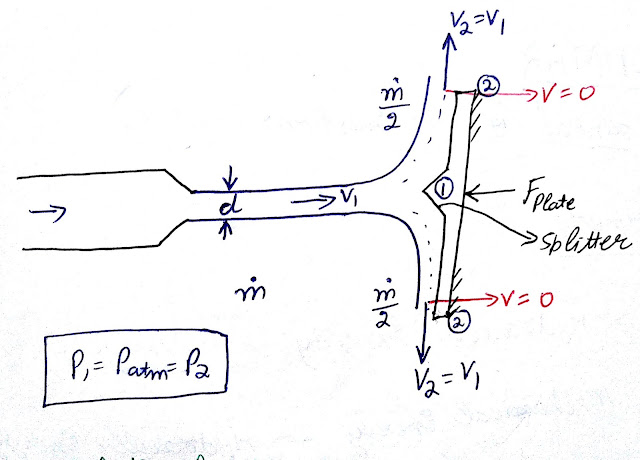
Jet strikes on vertical stationary flat plate Let us consider a stationary vertical plate on which a jet is striking. The jet is having diameter 'd'. The mass flow rate of Jet is represented by 'm' kg/s. This simply means that 'm' kilogram of water is coming out of nozzle per second. The jet is striking at the middle of the plate with velocity 'V1' metre per second. After the impact of Jet on the plate, the jet will split equally and flows over the plate. After that the jet will exit the plate from its tip in tangential direction. Now here Jet is striking the plate normally or perpendicularly at point 1 and exit the plate tangentially from the tip of the vertical plate represented by point 2 with velocity 'V2' m/s. If we consider this plate to be frictionless then the entry velocity and exit velocity will be same (V1=V2). Also the pressure throughout the plate is atmospheric, wheather it will be on entry point of plate which is point 1 or it...

Lecture - 2 (impact of jets)

Image
Before starting with impact of jets we must learn about forces. Force is nothing but rate of change in linear momentum. When we apply force on a body, than its Momentum will change and this change in momentum will represented by subtraction of initial momentum of body from its final momentum. Force applied on a body = final momentum of body - initial momentum of body Let us consider a stationary vertical plate on which a jet is striking. The jet is having diameter 'd'. The mass flow rate of Jet is represented by 'm' kg/s. This simply means that 'm' kilogram of water is coming out of nozzle per second. The jet is striking at the middle of the plate with velocity 'V1' metre per second. After the impact of Jet on the plate, the jet will split equally and flows over the plate. After that the jet will exit the plate from its tip in tangential direction. Now here Jet is striking the plate normally or perpendicularly at point 1 and exit the plate tangential...

Lecture - 1 (Introduction of hydropower turbines)

Image
Turbines Hydropower turbines are the rotary Machines which convert Kinetic and pressure energy of water (or we can say that dynamic and static head of water) into mechanical energy.  Some turbines convert only kinetic energy or dynamic head of water into mechanical energy and some turbines uses both kinetic energy and pressure energy of water into mechanical energy. Right now it's little bit confusing but dont worry we will have a detailed discussion on each and every points in my upcoming lectures. Classification of hydropower turbines based upon energy available at inlet to Runner  Impulse turbines Reaction turbines Based upon direction of flow of water with respect to Runner Tangential Axial Radial Mixed Based upon specific speed Based upon head and discharge For high head and low discharge - PELTON TURBINE For medium head and medium discharge - FRANCIS TURBINE  For low head and high discharge - KAPLAN TURBINE and PROPELLER T...

Frequently asked intresting facts - 3

Image
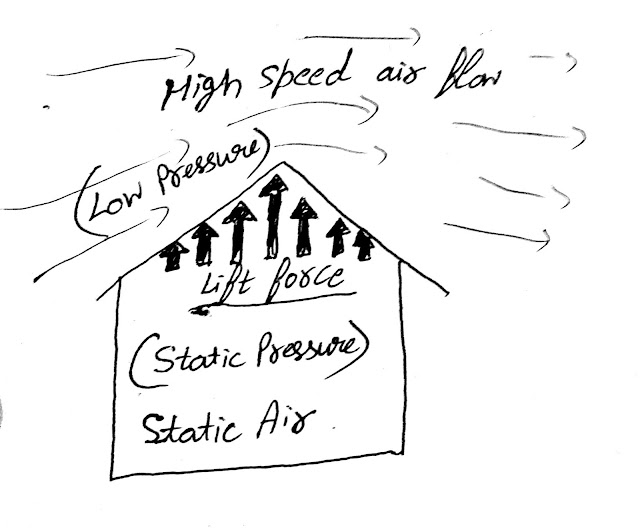
When you don't know swimming your body will drowned into water but when you are dead your body floats on the surface?   A body will float when the weight of the body is less than the weight of the fluids it displaces. When a body start to drown in water firstly the air in the lungs is replaced by the water and hence density of the body is much more than density of water therefore firstly the body sinks.  But after sinking the bacteria in the body start decomposing the body due to which gasses like methane, carbon-dioxide are released due to which body starts to bloat or swells up and increases in the volume so that average density of body decreases and now it can displace more water, as density of body became less than water now body start to floats on surface. This happens approximately after 24 hours of drowning. High speed wind tends to lift the roof why? Hey guys before understand this first go through the relation between pressure and velocity which is mentio...

Frequently asked intresting facts - 2

Image
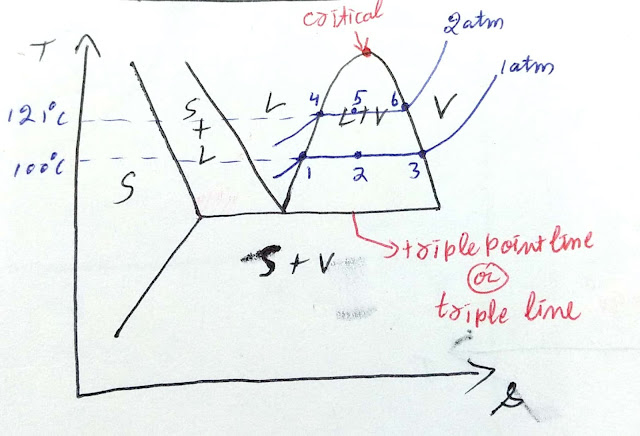
What is triple point or what is its significance or what is the difference between triple point and critical point?  There are 15 possible diagrams in Thermodynamics which are made with the different-different combination of 6 Thermodynamic properties which are pressure, temperature, volume, internal energy, enthalpy and entropy. Now all these 15 diagrams are constructed by taking a reference point on which all the three form of water exist, that's solid, liquid and gas. That point is known as triple point. Actually if we observe in detail, triple point is not a point in 14 out of 15 diagrams. It is a line and this line is known as triple line. Let me show you in example of 1 diagram out of those 14, that's temperature vs entropy diagram as shown below Likewise 14 diagrams are there on which triple point is a line. Only one diagram is there in which triple point is a point and that is pressure vs temperature diagram. In this diagram phase change region is also absent. P...

Lecture - 7 ( temperature and thermometer )

Image
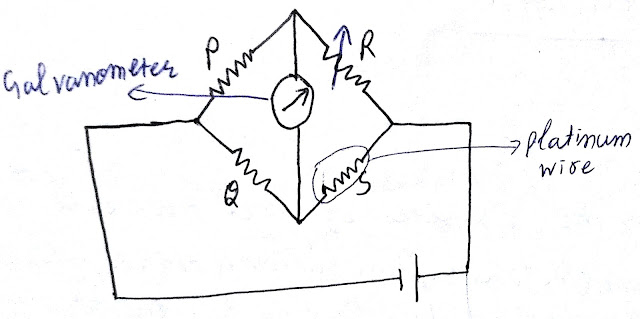
Temperature  Temperature is a parameter which represents average random energy per unit molecule. As random energy per unit molecules decreases then it means that temperature will get reduce and vice-versa. For more details on temperature or difference between temperature and heat check out  Lecture - 6 . Conversion of celsius to fahrenheit scale  There there is no Rocket Science behind it you just need to remember a simple formula for this conversion and that is- T c / 100 = (T f - 32) / 180 'T c ' represents temperature in degree Celsius scale 'T f 'represents temperature in fahrenheit scale Celsius and Fahrenheit scale are based upon 2 reference points which are boiling and freezing. In Celsius scale 0 denotes the freezing point of water and 100 denotes the boiling point of water. Whereas in fahrenheit scale reading of 32 denotes freezing point of water and reading of 212 denotes boiling point of water. Conversion of celsius to kelvin scale  F...